Japan is well-known for its delicate local etiquette, long-standing cultural customs, and unspoken social rules. Many innocent-seeming moves from foreign travellers may accidentally offend locals, cause awkward moments, or even break local laws.
I have sorted out 30 common taboos covering dining rules, public-transport manners, social habits, and traditional superstitions. Keep this checklist handy before you land in Japan, and enjoy a smooth, respectful vacation.
Skip hours-worth of exhausting online research. Grab my printable, well-organised PDF travel blueprint for your Japan journey.
Get the PDF Guide →Part 1. Daily-Life & Social Cultural Taboos
1. Do Not Smoke While Walking
Many Japanese cities ban on-the-go smoking. Law-breakers will face fines starting from 2,000 yen. Always seek out fixed smoking zones — they’re marked with signage and often found near major stations.
2. Refusing Your Superior’s Drinking Invitation May Bring Workplace Trouble
Turning down drinks from your boss is commonly viewed as disrespect in Japanese workplace culture. It is socially tricky whether you attend the drinking gathering or decline politely. If you’re a tourist, this won’t apply — but it helps you understand the deep-rooted nomikai (drinking party) culture.
3. Never Fasten Your Kimono with the Left Side Over the Right
Kimono dressing rule: right-over-left for living people. Left-over-right is only used for the deceased in funeral rituals. Wearing it wrong is considered extremely inauspicious — if you’re renting a kimono, the staff will dress you correctly, but it’s good to know.

4. Do Not Wear Your Bathroom Slippers Outside the Restroom
Special-purpose toilet slippers belong only inside lavatories. Taking them out spreads bacteria across floors and is seen as rude. You’ll encounter these in ryokan, traditional restaurants, and some homes — there’s usually a clear distinction between indoor slippers and toilet slippers.
5. Do Not Call Out “Waiter” Loudly Inside Restaurants
Japanese diners say sumimasen (excuse me) to call for staff service. Loud shouting will create discomfort for surrounding guests. A quiet hand raise combined with sumimasen is the correct way.
6. Stay Off the Central Walking Path at Shrines and Temples
The middle pathway of Shinto shrines is treated as the sacred road for deities. Tourists should walk along both-side lanes and avoid photographing the central aisle. This applies especially at major shrines like Fushimi Inari and Meiji Jingu.

7. Avoid Answering Phone Calls While Taking a Bath
Bathing stands for spiritual purification within Japanese traditional belief. Receiving calls while showering ruins the cleansing ritual. This is more about cultural sensitivity — in practice, just keep your phone away from the bathroom in ryokan settings.
8. Do Not Help Others Fasten Neckties Except Your Romantic Partner
Tying another person’s necktie carries an intimate meaning in Japan. Strangers doing so will create serious misunderstanding. Keep this in mind in professional or formal settings.
9. Eating and Walking Is Generally Frowned Upon
Except for food-shopping streets in scenic spots (like Nishiki Market in Kyoto or Takeshita Street in Harajuku), locals think eating on-the-move looks sloppy. Step aside, finish your snack at a bench or near the vendor, then continue walking.
10. Think Twice Before Sitting Next to Elderly Passengers on Trains
Some senior citizens may misinterpret your seat choice and feel you avoid them on purpose. This is subtle and not a hard rule — just be aware that spacing on Japanese trains carries more social weight than in Western countries.
11. Avoid Saying Sayonara for Everyday Goodbyes
This phrase carries the heavy implication of permanent separation. For daily farewells, use matane (see you later) or osakini shitsurei shimasu (polite “I’ll be leaving first”). Save sayonara for when you genuinely don’t expect to see someone again.
12. Visitors with Visible Tattoos Cannot Enter Public Hot Springs
Tattoos were historically linked to gang culture in Japan. Most standard public onsen strictly reject guests with visible tattoos. However, the landscape is slowly changing.

Travel Tip: If you have tattoos and plan to experience Japanese hot springs, I have curated a list of tattoo-friendly onsen and private hot spring accommodations. You can easily book private onsen rooms without worrying about local restrictions.
13. Never Borrow an Umbrella from Other Households
The Japanese word for umbrella (kasa) sounds similar to the word for “dissolution” or “separation.” Lending umbrellas symbolises broken-off relationships. Convenience stores sell cheap umbrellas for about 500 yen — just buy your own.
14. Do Not Bargain Over Prices in Regular Shops
Haggling is regarded as disrespectful towards shop-keepers in Japan. The listed price is the price. You can negotiate only inside electronics stores (like Yodobashi or Bic Camera, where price-matching is common) and second-hand markets.
15. Never Snap Photos of Geisha Without Permission
Geisha regard unapproved photography as harassment, and they may ask you to delete pictures. In Kyoto’s Gion district, unauthorized photography of geisha and maiko is now banned on private streets with fines. Admire respectfully from a distance.
16. Wedding Rings Are Worn on the Right-Hand Finger
The left ring-finger historically symbolises widowhood and divorce in local custom. If you’re married and visiting Japan, switching your ring to the right hand is not necessary as a tourist — but it’s an interesting cultural note.
Part 2. Dining Manners & Common Tourist Mistakes
17. You Can Slurp Noodles Loudly
Loud slurping tells chefs you love the noodle dish — it’s a compliment, not rudeness. Chewing food with your mouth open and making smacking noises, by contrast, signals bad table-manners. The distinction: slurping = good, smacking = bad.
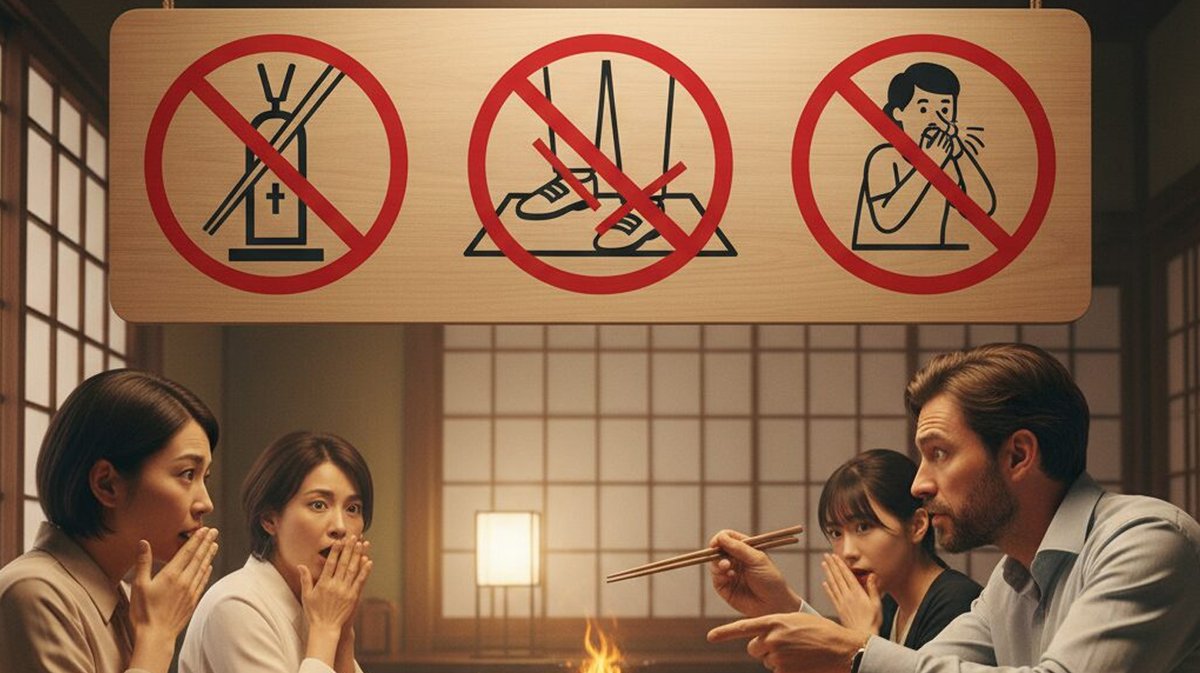
18. Never Stick Chopsticks Upright Into Bowls of Rice
Vertical chopsticks inside rice bowls replicate funeral offerings for the dead (hotoke-bashi), and it is an ominous gesture. Always rest chopsticks on the provided chopstick rest (hashioki) or horizontally across the bowl.

19. Do Not Transfer Food Directly Between Pairs of Chopsticks
This custom mimics bone-handling rituals at Japanese cremation ceremonies. Pass food over onto the other person’s plate using serving chopsticks instead. This is one of the most serious dining taboos — avoid it entirely.
20. Do Not Pour Drinks Only for Yourself
Social dining etiquette requires you to refill companions’ cups first, then they will top up your drink in return. Hold the bottle with both hands when pouring for someone else, and lift your glass slightly when receiving.
21. Always Remove Footwear When Entering Private Homes or Traditional Ryokans
Dirty outdoor shoes indoors are extremely impolite. This rule strictly applies to all traditional Japanese inns, some restaurants with tatami seating, temples, and private homes. You’ll usually find a genkan (entryway) with slippers provided.
Travel Tip: Traditional ryokan stays are the most authentic way to experience Japanese local culture. I have selected top-rated, traveller-friendly ryokans across Tokyo, Kyoto and Osaka through reliable booking platforms for your seamless stay.
22. Phone Calls Are Banned Inside City Trains
If your mobile rings on public transit, briefly explain you are aboard a train and hang up straight away. Keeping quiet on public transport is basic Japanese etiquette — most passengers switch their phones to silent mode (manner mode).

Travel Tip: To travel smoothly across Japan’s vast public transport network, you can pre-purchase your JR Pass and subway tickets via my recommended booking links, saving time and avoiding on-site queue trouble.
23. Blow Your Nose in Restrooms Only
Public nose-blowing is considered gross and socially unacceptable in Japan. If you have a runny nose, excuse yourself to the restroom. Sniffling is tolerated (though not ideal) — but never blow your nose at the dinner table or on public transit.
24. Hand Money Over Via the Payment Tray
Direct skin-to-skin cash hand-offs are seen as rude in Japan. Place banknotes onto the small counter tray provided at every register. This applies at convenience stores, restaurants, and ticket counters.
25. Never Photograph Strangers Without Consent
Local residents attach great importance to portrait rights. Unauthorised snapshots may lead to police reports. This applies especially to children, geisha/maiko, and anyone in traditional attire. Always ask permission first.
26. Stay Away from Unlucky Gift-Giving Customs
- Items in sets of four: The number four (shi) sounds like the word for “death.”
- Combs and handkerchiefs: Combs (kushi) sound like “suffering” and handkerchiefs symbolise farewell tears.
When buying souvenirs or gifts, avoid these items.
27. Keep Your Rice Bowl Below Head-Height
Holding bowls high above your head resembles beggar behaviour in Japanese culture. Bring food gently to your mouth — pick up small bowls (rice, miso soup) and bring them closer, rather than leaning down to the table.
28. Remember Cash-Giving Number Rules
Odd-numbered cash envelopes are prepared for weddings (indivisible, lifelong-union meaning). Even-numbered sums are used for funeral-related gifts. Do not mix up the rule. As a tourist, you’ll rarely encounter this — but if invited to a Japanese wedding, remember: give an odd number (typically 30,000 yen in crisp new bills).
29. Never Point Scissors or Sharp Blades Toward Other People
Pointed sharp objects carry the hostile metaphor “I will cut you” in Japanese body language. Never play-point blades to friends, and when handing scissors to someone, offer the handle side.
Closing Words
These 30 etiquette rules help foreign travellers fit into Japanese local social norms and prevent unintentional offence. Cultural respect will greatly upgrade your whole travel experience.
Whether you are planning a short city break or a long cross-country Japan trip, mastering these basic manners will help you blend in with locals and enjoy a more authentic travel journey. Print this checklist, save it to your phone, and refer to it during your trip — your effort to respect local culture will be noticed and appreciated.